Chromebook asset management

Chromebook asset management for schools.

Every Chromebook from Google Admin, beside your tickets: where it is, who has it, what happened to it, a label on the lid.

Connect your own Workspace in the pilot. No card, no sales call.

Google Admin

Synced from the Admin console, read-only.

A Workspace administrator connects once from Admin → Import. Every field and rule is on the Chromebook inventory page.

Annotated user becomes the holder

When the annotated user is in Beacon, the device is checked out to them. Recent sign-ins are information only.

Annotated location becomes a room or cart

“Lincoln High School - Room 204” or “LHS / Cart 3” files the device in that room or cart, created if new.

Most recent user, if you opt in

One switch assigns a device with no annotated user to its most recent managed Google user.

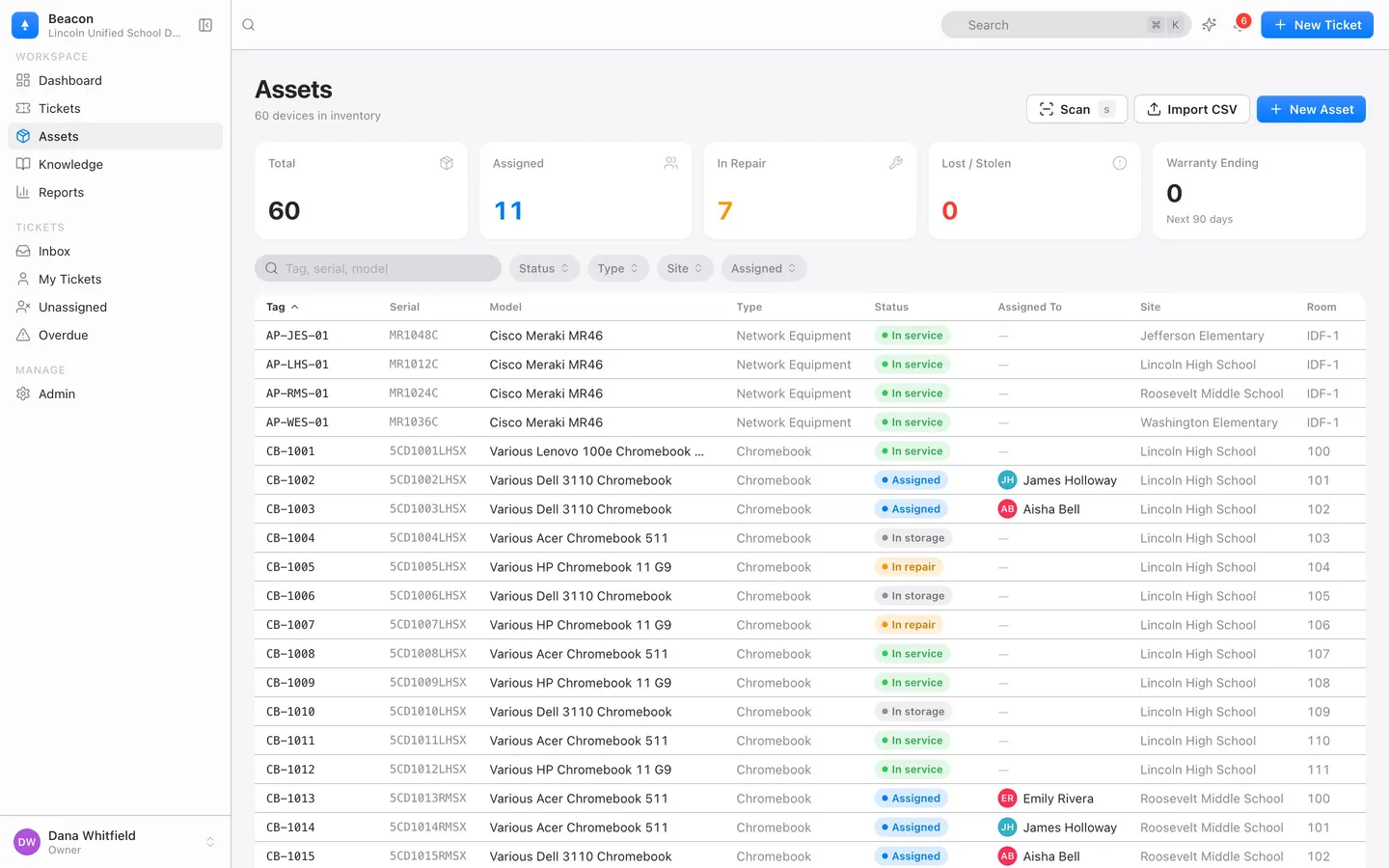
The Beacon assets list in the sample district, with tag, serial, model, type, status, assigned user, site and room columns

The assets list in Beacon’s sample district.

The sync runs after 2 AM in your time zone, or on Sync now. A technician's In repair or corrected tag stays put, nothing is deleted, and CSV or Incident IQ imports are matched by serial number, not duplicated.

Where it is

Sites, rooms, carts, closets, labs.

Created the first time someone names it

  • On a device's form or Move dialog.
  • At check-in, under Where it goes.
  • In an import's Room, Room Number, Classroom or Cart column.
  • In Place mode, on a bulk move, from Google's annotated location.

Moved one or five hundred at a time

  • One: Move on the device page, holder untouched.
  • Many: tick devices on Assets, then Move to location, up to 500 at once.
  • By scanning: choose Place, pick the cart once, scan back to back.

Found by where

  • A Where column, a Location filter, Group by location and a page per location.
  • Every move is in the device's history. Ask Beacon answers “how many Chromebooks are at Lincoln High School”.

The locations guide.

Who has it

Check-out, check-in, loaners.

Who holds a device and where it sits are separate facts.

Check out

A person, an optional note and due-back date, empty for 1:1 or set for a loaner. The holder sees the device on their portal.

Check in

A note, a new status and Where it goes in one step, recorded in the device's history with who and when.

At the counter

Scan takes a barcode scanner or a typed tag: Open opens the device, Check out assigns each scan to one person, Place files each in one location. The iOS app's camera (the app is in testing on TestFlight) reads Code 128 and QR codes and opens the device with its holder, location, history and open tickets.

Statuses: In service, Assigned, In repair, In storage, Loaner, Lost, Stolen, Retired, Disposed. Purchase date, cost, warranty, funding source and vendor feed reports by status, type and site, and warranties ending in the next 90 days. The assets guide.

Labels

A label on every lid.

The asset tag in large type, a Code 128 barcode, a QR code that opens the device, serial, make, model and district name. Print from the device page, a selection, an import or each scan, on Dymo 30252 and 30336, Brother DK-1201, Avery 5160 and 5163 or a custom size, nothing fetched from a third party.

Two fleets

The 1:1 district and the shared-cart district.

Carts in some grades, 1:1 in others, nothing to configure.

1:1: one student, one Chromebook

  • People come from a CSV, nightly from Google Workspace or Microsoft Entra, or single sign-on.
  • Swaps and loaners are a check-in and a check-out with a due-back date.
  • Repair tickets link to the device, and the device page lists every one.

Shared carts and labs

  • Annotated locations become carts, or Place mode scans a cart's worth in a minute.
  • Leave the most-recent-user switch off and sign-ins never reassign a shared device.
  • Moving a cart to another room is one bulk move, recorded on every device.

Student data

What Beacon stores about a student, and what it does not.

Stored

  • A person record: name, email, role (requester, for a student), school, and optionally title and phone from your import or directory sync.
  • Their devices, with dates, and the requests they submit.
  • Per device from Google Admin: serial, asset ID, model, status, annotated user and location, organizational unit, OS version, enrollment and last-sync times, auto-update expiration, MAC address, the notes field, and up to five recent managed sign-ins.

Not stored

  • No grades, attendance or guardians. Students' grade levels come from the PowerSchool or ClassLink sync, and homerooms and class schedules from PowerSchool, where a district turns them on.
  • No browsing history, files or screen content.
  • No location tracking: “where it is” is the room a technician or Google named.
  • Nothing written back to Google. No advertising, no trackers, no sale of data, and AI is never trained on your data.

FERPA, COPPA, SOPIPA

Beacon acts as a school official under your direction, collects nothing from children under 13 except through the school, and signs the SDPC National Data Privacy Agreement and state addenda on request. Student data on the security page.

Export and deletion

A JSON bundle of everything, any time, on every plan. A school can delete any record, an owner the whole organization.

Isolation

Every district lives behind Postgres row-level security.

Questions

Asked by the person who runs the fleet.

Do we have to type our rooms and carts in first?

No. A location is created at its site the first time someone names it: on a device's form or Move dialog, at check-in, in an import's Room column, in the scanner's Place mode, on a bulk move, or from a Chromebook's annotated location in Google Admin. Administrators can rename, re-kind or delete them under Admin → Sites; deleting one asks where its devices go.

Does checking a device out to a student move it out of its cart?

No. Where a device sits and who holds it are two separate facts. A Chromebook checked out to a student for the weekend still belongs to Cart 3, and goes back to it, or wherever you say, at check-in.

Will the nightly sync reassign a cart Chromebook to whoever used it last?

Not unless you turn that on. By default a device is assigned only to the annotated user in Google Admin, when that person is in Beacon; who signed in recently is kept as information. The opt-in switch assigns a device with no annotated user to its most recent managed Google user, and states the trade-off: a shared device may change hands as people sign in. An annotated user always wins, a held device changes hands only when its most recent user changes, and a sync never unassigns.

What does a student see?

A student signed in to the portal sees their own requests, the devices checked out to them, and the public knowledge base. They do not see other people's devices or tickets, the device history, or anything from Google Admin.

Can we manage Windows laptops, iPads and projectors too?

Yes. Nine asset types come ready, each with its own fields, and an import creates a type it does not know. Devices from Intune reads every device managed in Microsoft Intune, Windows laptops and iPads included, read-only and nightly, on the district's Microsoft Entra connection, which an Entra Global Administrator connects once. Devices from Mosyle syncs the iPads, iPhones, Macs and Apple TVs in Mosyle Manager, read-only and nightly, on the district's own Mosyle Manager API token. There is no sync from SCCM or Jamf: those devices, and anything else such as projectors, come in from a CSV or a paste from a spreadsheet on Admin → Import, matched by asset tag or serial number; a re-run updates rather than duplicates.

Does Beacon change anything in Google Admin?

No. Beacon asks Google to read Chrome devices and, for the people sync, users and group members, plus the email address of the administrator who connected. It never changes a device, a user, an organizational unit or a setting in Google, and disconnecting deletes the token and revokes the grant.

What happens when a student leaves?

Check the device in, choosing its new status and where it goes, then disable or delete the student under Admin → Users. A person who requested tickets is disabled rather than deleted so those tickets keep their requester; the tickets themselves can be deleted. A school can delete any record at any time, and all of a school's data is permanently deleted within 30 days of its request or the end of its agreement.

Can we try the Google Admin sync during the pilot?

Yes, in your own pilot organization: connect your Workspace from Admin → Import. The emailed demo district is a made-up sandbox and cannot connect to a real Google Workspace.

What does it cost?

Devices are part of every plan, not a module. Starter is free for good for one school with up to 1,000 devices. District is $1 per student per year with every module, unlimited devices and sites, and a $900 per year minimum; the pilot is free for 90 days with no card. Pricing.

Do we need a student data privacy agreement first?

Before you import real students and staff, yes: email hello@beaconhelpdesk.com and Beacon signs one, including state model agreements such as the SDPC National Data Privacy Agreement. The pilot's sample data contains no real people, so you can try the product before that.
Get started

Connect Google Admin in your pilot this afternoon.

The full District plan for 90 days, and nothing converts on its own. Switching from Incident IQ? What a district gains and gives up.